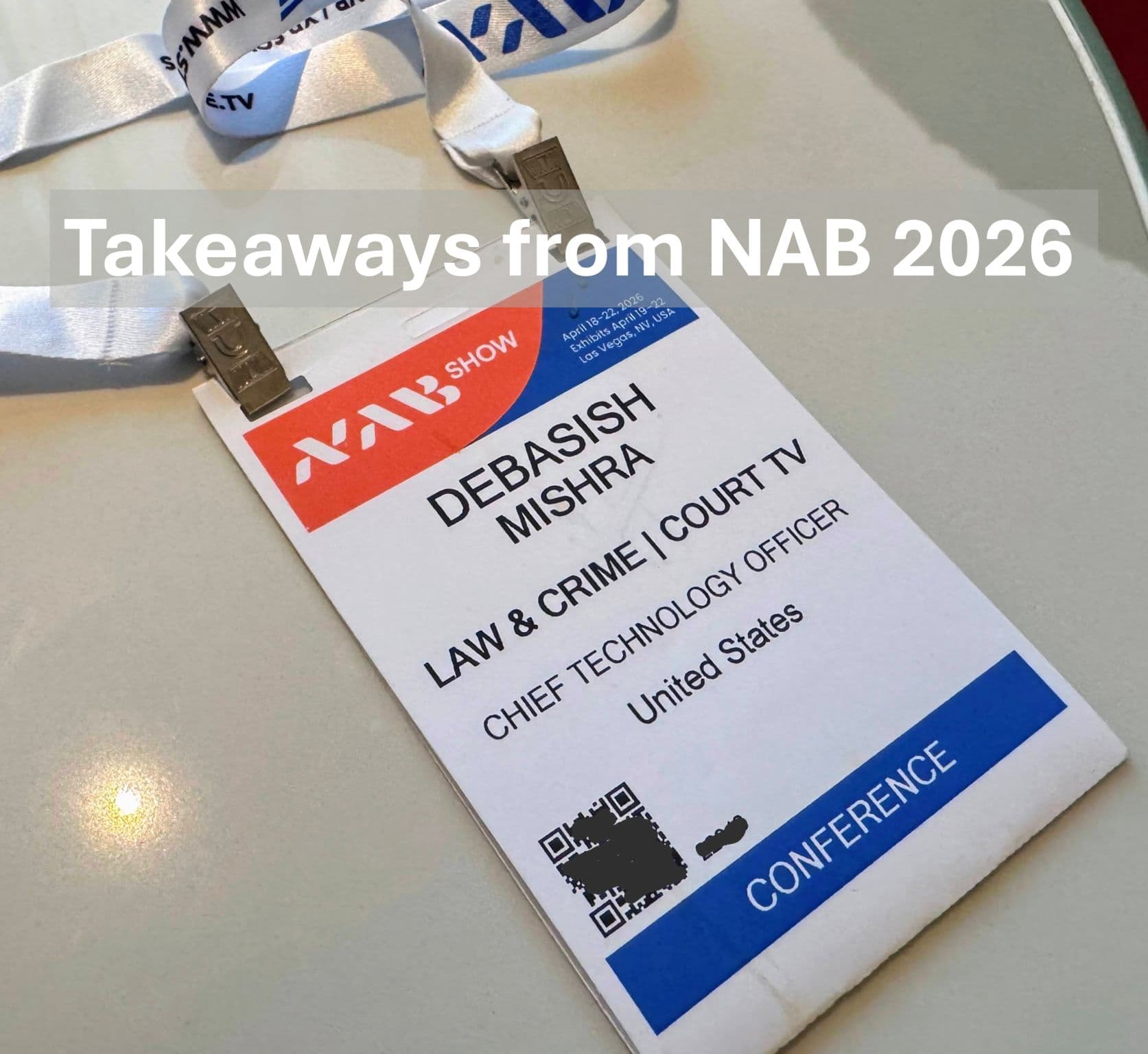
Just got back from NAB. The show was smaller than prior years, but the vendors I spoke with said that while they perceived lower attendance, they were seeing more buyers. It did seem less crowded than prior years, but that also lined up with why I was there. Here's what I saw.
AI is the new cloud
The buzzword cycle is in full swing. "AI" appeared in nearly every product name and press release on the floor, regardless of whether the underlying capability was meaningfully intelligent or simply automated. We saw the same pattern with "cloud" a decade ago. Some of what's being shown is genuine. Much of it is branding. The discipline, for buyers especially, is knowing which is which before you commit.
Cloud-based master control is having a moment
A meaningful number of vendors were showing cloud-native master control solutions, a sign of growing awareness that automation and cloud infrastructure offer scalability and resilience that traditional setups can't match. As content delivery expands to streaming, connected TV, and social, the old architecture wasn't designed for that many endpoints. This shift is overdue, and it drives an even greater shift to IP delivery.
The rise of cloud-based monolithic architectures
Across the vendor landscape, a consistent pattern: each solution covers a legitimate slice of the media value chain, rights management, post-production, social clipping, syndication screeners. Each one uses AI-generated metadata about media assets to deliver genuine value, as long as you index with their AI, but especially if you store your video with them.
No one explained why you have to use their storage, but I suspect the reason isn't technical. It's economic. It's the old lock-in strategy. They've structured their margins around hyperscaler storage, not the value of the product. Your assets become the collateral that keeps you on their platform.
For any media company with a meaningful video library, the math gets uncomfortable fast: duplicate assets across multiple providers, redundant AI indexing jobs, no single source of truth. One firm I encountered had even built a metadata synchronization tool just to manage the inconsistencies. That's not a product feature. It's a workaround for an architecture that isn't serving buyers.
The model that Law & Crime will be pursuing: store once, index once, and let services compete on what they actually create. Vendors confident in their real value proposition don't need your storage as collateral. An open architecture is a tell. So is a walled one.
The best part of NAB, of course, is the chance to reconnect with partners and colleagues and to make new ones.