Last week, I wrote about public media's habit of flying blind, the critical lack of instrumentation and feedback loops in an industry now fighting tooth and nail for audience attention.
The existential shift public media needs to make isn't just about building a data analysis muscle and some nice dashboards. It's about fundamentally changing the operating model to one where data informs every stage of achieving the mission.
There's no need to reinvent the wheel to see what this looks like in practice. We just need to look at the most successful media operating model of the last two decades: Netflix.
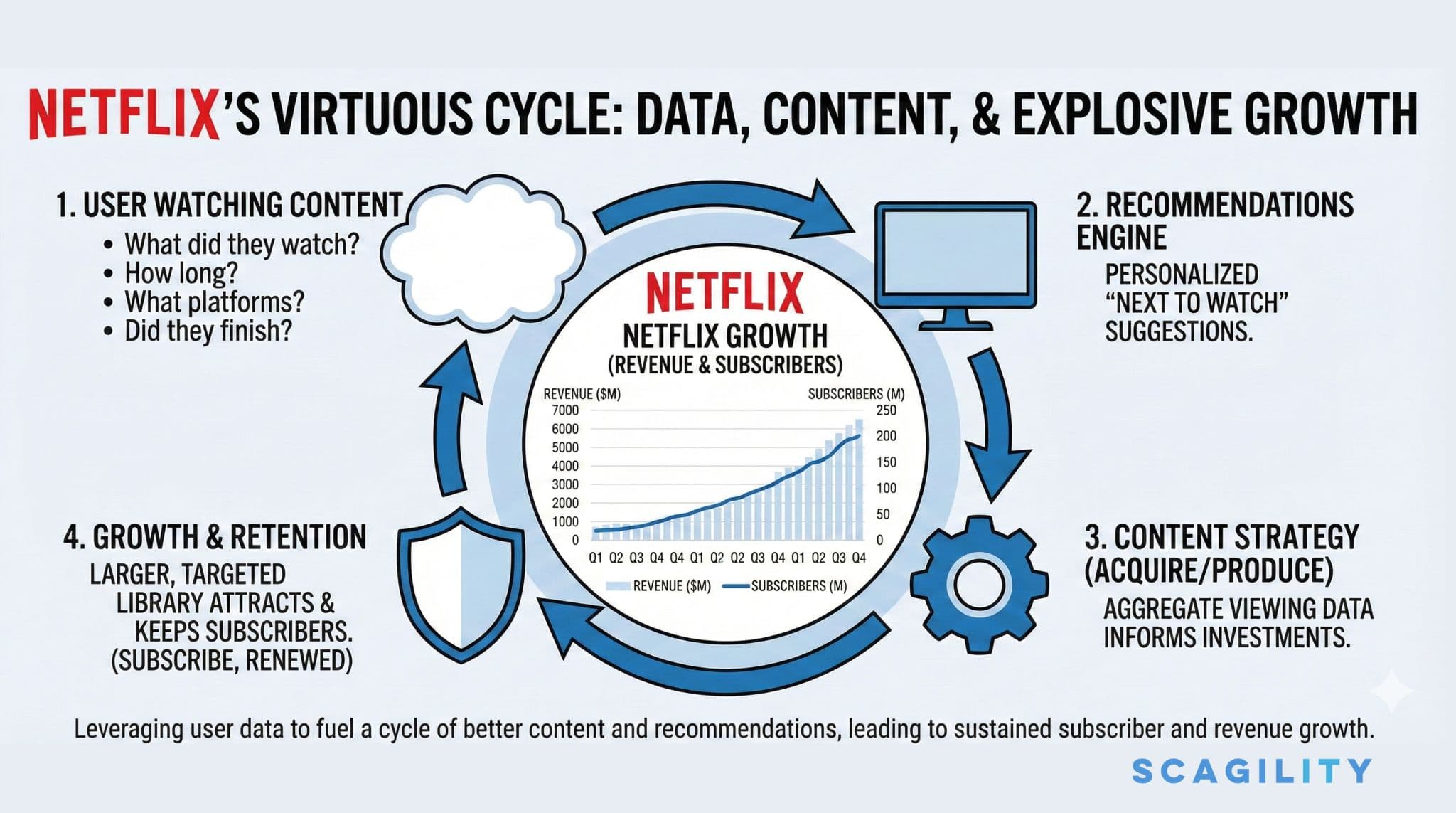
Netflix achieved 40 consecutive quarters of both revenue and subscriber growth from the launch of their streaming service. That level of sustained velocity doesn't happen by accident, or by just having good creative instincts. It happens because they built a flywheel operating model.
Netflix didn't treat digital as a side channel to their DVD business; they made it the core engine. They don't treat data as a retrospective report card; they use it as the fuel for the entire system.
Here is the breakdown of their flywheel:
- Granular viewing data (what you watch, when you pause, what you binge) feeds the...
- Recommendation engine, which personalizes the experience and increases watch time, which generates...
- Aggregated insights that directly dictate content strategy (what to acquire, what to produce, and how much to spend), which creates a...
- Targeted, high-value library that drives new acquisitions and retains existing subscribers.
I know some public media leaders are thinking: "We aren't Netflix. Our funding comes from grants, members, and institutions, not just subscriptions."
That's true. Adopting a data-driven operating model is not mutually exclusive from traditional institutional giving.
In the attention economy, you are competing with Netflix on the same battlefield every single day. If you cannot capture attention, your mission fails.
Public media needs its own version of this flywheel. It needs a data-centric approach that grows audience engagement, which in turn proves value to donors and grantors, funding better content, which attracts larger audiences.
Creating this virtuous feedback loop is what can help keep public media moving forward.