I appreciate John Oliver's season finale of Last Week Tonight highlighting the invaluable role of public media, from education to local reporting, and the very real threat posed by political efforts to defund it. I agree with his premise: public media is a cornerstone of our democracy.
Having spent years as the CTO of a leading PBS station, I have to inject a hard dose of reality that was missed. The political threat is merely accelerating a strategic vulnerability that public media has faced for nearly a decade: a failure to fully and urgently pivot to a digital-first audience strategy.
The challenge isn't just surviving political maneuvers. It's proving relevance to the taxpayer. With a rapidly declining audience base, it becomes exponentially harder to justify the value of public funding. This makes audience growth and retention an absolute imperative, not an optional priority.
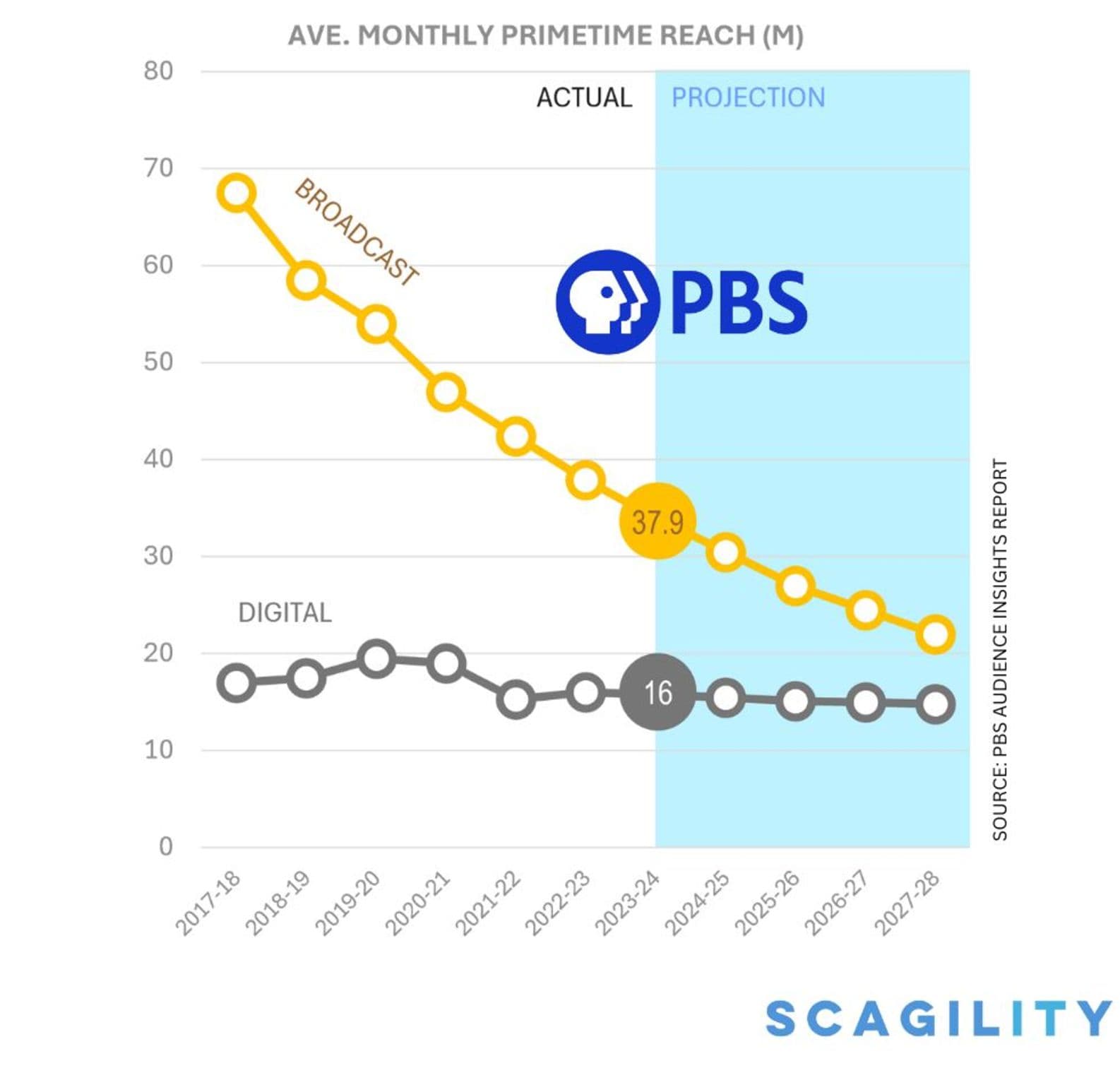
The primetime audience has dropped nearly in half over the past five years and is projected to continue to decline. In stark contrast, the crucial digital audience remains flat.
This trend illustrates where the critical gap lies. While the traditional broadcast model contracts, the organization's investment in digital skills, infrastructure, and innovative product development has not kept pace. This has created an unsustainable reliance on legacy systems and structures, and worse, well-meaning but inefficient initiatives to become digitally relevant.
I witnessed firsthand the talent and commitment within public media, but also the structural impediments: a risk-averse culture, and a decentralized system where the national organization was often unresponsive to the acute, local needs of member stations.
The funding cuts force a decision point. Public media must stop viewing digital strategy as an ancillary distribution channel and see it as the core engine for growth and renewal.
This requires:
-
Shifting from a broadcast mentality to a user-centric, multi-platform product strategy focused on growing the digital connection between local stations and the communities they serve.
-
Investing in digital talent, data scientists and product managers, over maintaining outdated legacy systems.
-
Creating a more agile and service-oriented national structure that empowers local stations to innovate and serve their communities digitally.
The challenge isn't just saving public media. It's reimagining its operational model to ensure its value to local communities and the country at large is undeniable for years to come.