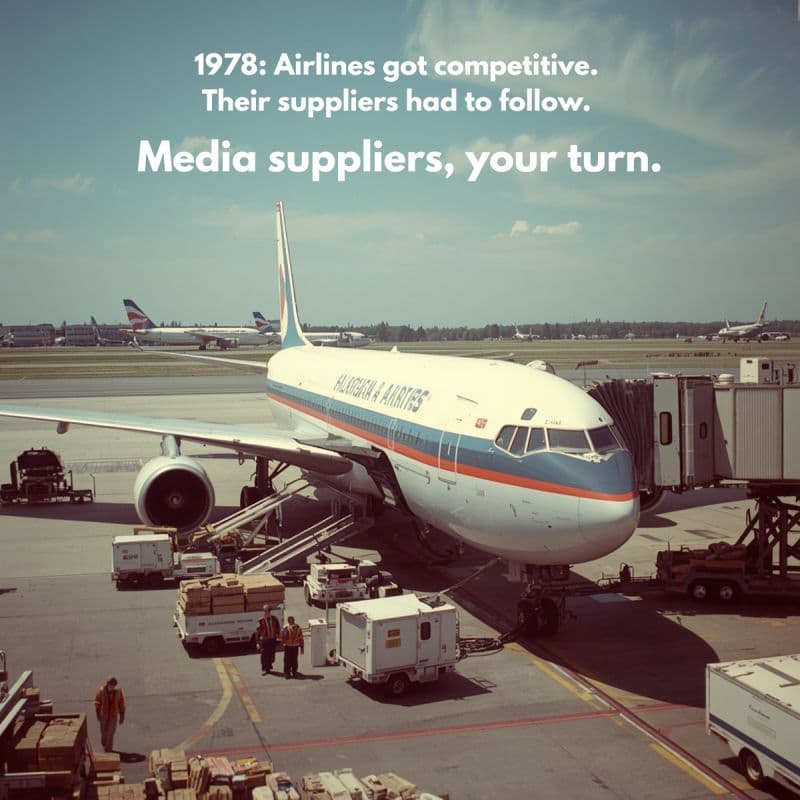
When the airline industry was deregulated in 1978, carriers that had operated as protected utilities suddenly faced competition they had never experienced. The ones that survived didn't just change their routes. They tore apart their cost structures, line by line. Airport fees. Fuel contracts. Maintenance agreements. They built procurement disciplines that turned supplier relationships from handshakes into performance obligations. The ones that didn't, most of them, are gone.
I'm heading to the NAB conference this week thinking about that.
The prevailing narrative around media layoffs is strategy failure: wrong streaming bets, misread audience shifts, overbuilt content slates. That's real. But there's another story that doesn't get told enough. These are also operational management failures, built up over years of not asking suppliers to reflect the same pressure the industry is under.
Our acquisition of Court TV gave me a close look at channel origination and distribution. What I found was layers, program, schedule, traffic, rights, measurement, QoS, CDN, OVP, SSAI/DAI, each with a vendor (or several) taking a cut. The marginal cost of launching a new channel on a new platform should be declining as automation matures. In most cases, it isn't.
When I did data center transformations, cost reduction wasn't a hope. It was contractual. Service providers wrote year-over-year savings into their agreements because automation made it achievable and competition made it expected. In media, that discipline is almost entirely absent. Some vendors have little incentive to change because they've become de facto monopolies with no meaningful pressure to evolve. One vendor is so insulated from competition that it took them three weeks to contact me after the acquisition was announced, and then they stood me up for the meeting.
Three questions I'm asking of my vendor stack at NAB right now:
-
Where is your automation roadmap, and when do the savings flow to me? If a vendor has deployed AI and efficiency tools, those gains belong in the contract, not in their margins.
-
What is the marginal cost of the next channel, platform, or stream? If the answer isn't lower than it was two years ago, that's the conversation to have at NAB.
-
Which vendors in my stack are de facto monopolies? Those are the highest-risk supplier relationships, not because they'll fail, but because they have no incentive to improve.
The airlines that survived deregulation didn't just find new routes. They built the discipline to compete on cost. Media companies are going to need to do the same.